

Key Highlights
- SAP support tickets increase due to system complexity, frequent updates, and lack of real-time user support.
- Traditional training fails because users don’t receive guidance at the moment of task execution.
- Embedded learning delivers contextual, in-app support that helps users complete tasks correctly the first time.
- Reducing repetitive errors through embedded guidance significantly lowers support ticket volumes.
- Combining in-app support with simulation-based training improves user confidence and accelerates SAP adoption.
Introduction
SAP systems are the foundation of all operations. They drive finance, supply chain, manufacturing, human resources, procurement, and beyond. SAP S/4HANA is widely used with more than 400, 000 clients worldwide, and businesses make significant investments in ERP technology to promote compliance and productivity. However, technology alone can’t guarantee success. The degree to which employees can reliably use the system is the true differentiator.
SAP environments are tricky. End users frequently get overwhelmed by complex workflows, frequent updates, numerous modules, and role-specific workflows. It is difficult for employees to be prepared for real-world execution using traditional training methods like manuals, classroom sessions, learning modules. Thus, resulting in errors, slow adoption and increased support expense.
This is why, simulation-based training has emerged as a business norm. Simulations enable users to perform real transactions without taking any risk by providing safe and practical safe training.
Assima Train stands out as a powerful SAP simulation software that help enterprises in creating accurate, scalable and interactive SAP simulations.
The Significance of SAP Simulations in Enterprise Training
Businesses used Powerpoint presentations, user manuals and classroom sessions for years to train SAP end users. These approaches are instructive, but they fall short in preparing employees for system usage. SAP is transactional rather than theoretical. Users must do actual tasks confidently.
It’s risky to train team directly in a production system. Even the sandbox environment comes with restrictions. Sandboxes often fail to match the complexities of real system and need regular maintenance and updates. These results in unnecessary infrastructure cost and data integrity risks. Therefore, lot of businesses are looking for a reliable alternative of SAP sandbox.
This is where SAP simulation training redefines enterprise learning. Learners collaborate with a realistic simulation of SAP system that mimics real-world workflows rather than passively taking in information. A study in corporate training shows, hands-on improves retention by upto 75% as compared to lecture-based methods.
The main benefit of simulation is that they reduce fear. Many SAP users are cautious to learn more about the system because errors might have financial or operational consequences. A well-designed SAP training simulation fixes this concern by providing a safe environment to practice repeatedly.
For businesses implementing SAP S/4HANA, simulation-based training guarantees more seamless transitions, quicker user adoption and lesser post-go live disruptions.
Key Factors to Take into Account When Creating a SAP Simulation
Define Clear Learning Objectives
Clarity should be the first step in developing a SAP simulation. Specify the learners if they are finance analyst, HR administrators or managers and specify what success looks like.
- Are you limiting the number of invoice posting errors?
- Speeding up the month-end closure?
- Improving procurement cycle times?
Make sure simulations are in line with quantifiable business objectives like faster processing, better compliance or increased SAP digital adoption. Without clear goals, the development of SAP training content becomes unorganized and inefficient.
Comply to Actual Businesses Processes
Emphasising navigation rather than processes in ERP simulation training is a common error. Users only need to finish jobs, they don’t need to memorize T-codes. An effective SAP system simulation should replicate:
- Real workflows
- Approval hierarchies
- Handling exceptions
- Role-based authorization
Avoid generic situations disconnected from day-to-day operations. Interactive SAP learning must reflect real-life commitments to being efficient.
Keeping up System Accuracy
SAP environment update frequently. Training simulations needs to be accurate based on the current configuration whether you’re using ECC or SAP S/4HANA. Training might turn outdated quickly due to system upgrades, Fiori modifications and UI updates.
Outdated training effects user confidence and make things confusing for users. Update your SAP simulation software on a regular basis to make sure:
- Up-to-date workflows
- Proper fields and layouts
- Targeted developments
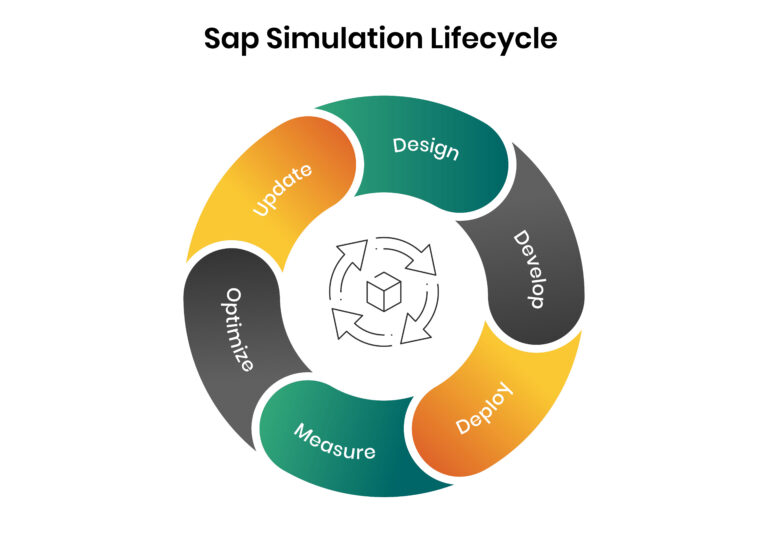
How Assima Train Simplifies SAP Simulation Creation?
Reliable technology is necessary to create SAP simulation at scale and Assima Train is an excellent choice in this regard. Here’s why:
- Cloning Technology
Assima Train precisely duplicates SAP screens using advances cloning techmology. It generates a fully operational SAP training simulation that mirrors the behavior of the actual system without depending on a live system sandbox, in contrast to conventional recording-based solutions. This cuts IT overhead and eliminates the need for constant sandbox maintenance.
- Quick Updates
SAP environments undergo constant changes particularly while implementing SAP S/4HANA. Assima Train supports quick content updates when system changes occur. Organizations can effectively update material in simulations assuring correctness and continuity, rather than starting from scratch.
- Enterprise Scalability
Big businesses need to train thousands of users in several location. Assima Train guarantees uniform SAP end-user training around the globe with its multilingual training capabilities and support for global deployment.
- Reduced Costs
It costs money to keep up duplicate sandbox environments. Being a dependable sandbox substitute, Assima Train drastically cuts down on time it takes to generate SAP training materials while eliminating duplication cost.
These key points position Assima Train as a top SAP simulation program for business.
Conclusion
The goal of creating a SAP simulation is to enable enterprise performance. SAP simulation training which is role-based, process-aligned and structured guarantees that employees can accurately and confidently use complex systems.
Simulation-based training is necessary as SAP environments become increasingly complex. Some of its long-term advantages include higher return, faster adoption, less errors and better compliance.
Hence, Assima Train is the go-to platform for business looking for a scalable, precise and affordable solution.