

Key Highlights
- SAP support tickets increase due to system complexity, frequent updates, and lack of real-time user support.
- Traditional training fails because users don’t receive guidance at the moment of task execution.
- Embedded learning delivers contextual, in-app support that helps users complete tasks correctly the first time.
- Reducing repetitive errors through embedded guidance significantly lowers support ticket volumes.
- Combining in-app support with simulation-based training improves user confidence and accelerates SAP adoption.
Introduction
Across large enterprises, SAP support queues are growing faster than ever. As a company migrates to SAP S/4HANA software, they get to face frequent system updates. Users also experience new workflows continuously as firms expand globally. Rising support tickets, overworked help desks, and irate staff are the inevitable outcomes.
The issue is not effort. It is timing.
Users need support at the moment they perform the task, not weeks earlier.
For this reason, top businesses are implementing embedded learning techniques. Organizations may drastically lower SAP support requests and stop errors before they happen by providing contextual help right within SAP workflows.
This strategy is made possible by platforms like Assima, which combine simulation-based training through Assima Train with real-time, contextual support delivered via Assima In-App Search to assist staff members while they work.
1. Why SAP Support Tickets Are Increasing
The rise in SAP support tickets across businesses is being driven by a number of variables.
First, the complexity of SAP environments has increased considerably. SAP S/4HANA combines linked modules, sophisticated data models, and real-time analytics. These features enhance corporate effectiveness, but they also necessitate more intricate workflow navigation for users. When procedures change, even seasoned workers may find it difficult.
Second, businesses update their SAP environments on a regular basis. New system features, regulatory updates, and configuration modifications are common. A slightly different workflow may be encountered today by users who mastered one technique six months ago.
Third, knowledge is not reinforced during execution in typical SAP training. Before going live, employees attend training sessions, but by the time they execute actual transactions, they frequently forget important processes. Retention rapidly decreases in the absence of reinforcement.
The lack of contextual assistance within SAP workflows is another significant reason. LMS-based SAP training programs or documentation libraries are used by many businesses. Users have to exit the system to look for solutions when they run into an issue. Productivity is slowed by this disruption, which frequently results in help requests.
Organizations that want to reduce SAP support tickets must address these structural issues rather than simply increasing training hours.
2. The Real Cost of High SAP Support Tickets

High SAP support ticket volumes create ripple effects across the organization.
- IT support teams become overloaded
Instead of concentrating on system optimization, innovation, or strategic initiatives, skilled SAP specialists spend a significant amount of their time answering recurring customer inquiries. This eventually limits the value that IT personnel can provide and lowers help desk productivity.
- Operational processes begin to slow down
Workflows halt while employees wait for assistance when they are unable to confidently complete transactions. Financial posts are delayed, procurement approvals stop, and reporting deadlines are longer than anticipated.
- Employee frustration increases
Repeated errors and uncertainty undermine confidence in the system. Instead of feeling empowered by SAP capabilities, employees start viewing the platform as complicated and difficult to use.
- SAP user adoption declines
When users hesitate to interact with SAP workflows or avoid system functionality, organizations struggle to realize the full value of their SAP investments.
- ROI from SAP transformations is delayed
Enterprises invest heavily in SAP transformation programs expecting automation, efficiency, and improved decision-making. Persistent SAP user support issues slow down those outcomes.
Reducing SAP support tickets is therefore not just an IT objective. It is a broader business performance priority.
Organizations that address these support challenges proactively improve operational efficiency, strengthen employee confidence, and accelerate the return on their enterprise SAP investments.
3. What Is Embedded Learning in SAP?
Embedded learning in SAP refers to delivering contextual guidance directly inside the system while employees perform tasks.
Traditional LMS-based SAP training provides structured knowledge but often lacks immediacy. Employees attend sessions or complete online modules outside the system environment. When they encounter a real workflow later, they must rely on memory.
Embedded learning works differently.
It delivers SAP in-app training exactly when users need assistance. Embedded learning in SAP is most effectively delivered through real-time, in-app support that allows users to access guidance, answers, and process knowledge without leaving the workflow.
This method is consistent with how people learn in the workplace. When workers apply new information right away, they learn it more efficiently. Additionally, embedded learning enhances retention. When instructions are displayed during actual tasks, consumers link learning to real-world application.
Embedded learning brings the same principle to enterprise SAP environments. In practice, this is achieved through a combination of simulation-based learning and in-app support tools that guide users both before and during task execution.
Explore how NPower improved SAP user adoption and reduced support reliance with Assima.
4. How Embedded Learning Reduces SAP Support Tickets
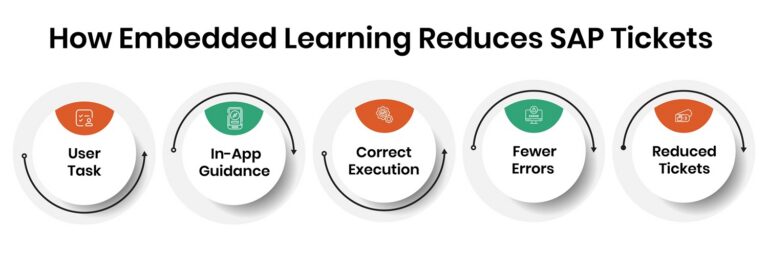
Embedded learning reduces SAP support tickets by addressing the most common causes of user errors.
Contextual Walkthroughs Prevent Errors
Embedded walkthroughs guide users through complex workflows step by step. Required fields, approvals, and validation rules become clear before mistakes occur. When users complete tasks correctly the first time, support requests decline.
Independent Problem Solving
Employees gain the ability to solve small issues independently. Instead of submitting a ticket for clarification, users receive contextual, real-time support directly within SAP through tools like Assima In-App Search, enabling instant access to answers without disrupting workflow
This reduces dependency on IT teams and empowers employees to continue working without interruption.
Reduction of Repetitive Queries
Multiple consumers often ask the same queries of help desk staff. By standardizing guidelines across departments and geographical areas, embedded learning significantly lowers the number of repetitive assistance requests.
Continuous Reinforcement
Traditional training happens once. Embedded learning reinforces knowledge continuously.
As employees perform transactions repeatedly, contextual support reminds them of correct procedures. This repetition strengthens retention without requiring additional training sessions.
Industry observations consistently show that most SAP support tickets originate from a small set of recurring workflows. When organizations embed guidance through tools like Assima In-App Search into those workflows, ticket volumes decrease significantly.
Embedded learning shifts the focus from reactive support to proactive enablement. Instead of fixing mistakes after they occur, enterprises prevent them entirely.
That shift is one of the most effective ways to reduce SAP support tickets and improve enterprise SAP user adoption.
5. How Assima In-App Search Enables Embedded SAP Learning
Assima In-App Search enables enterprises to deliver embedded SAP learning directly within live workflows.
The platform provides contextual, real-time support inside SAP, allowing users to instantly search for guidance, access process knowledge, and resolve issues without leaving the application. This ensures that employees receive the right information at the exact moment they need it, improving accuracy and reducing dependency on external support.
By making support available within the workflow, Assima In-App Search eliminates the need to switch between systems or raise tickets for common queries. Users can continue working without interruption, leading to faster task completion and fewer errors.
In parallel, Assima Train complements this approach by enabling employees to practice SAP workflows in simulated environments before working in live systems. This helps build confidence and familiarity, ensuring users are better prepared for real-world execution.
This combined approach ensures that employees are supported both during execution through in-app support and before execution through simulation-based training.
As a result, organizations reduce dependency on help desks, improve task accuracy, and accelerate SAP user adoption at scale.
Organizations using embedded SAP learning often report:
Lower volumes of repetitive help desk queries
Faster user proficiency during onboarding
Improved transaction accuracy across departments
Assima helps enterprises move from reactive SAP user support to proactive user enablement.
| Metric | What It Measures | Why It Matters |
|---|---|---|
| Support Ticket Volume | The number of SAP support tickets before and after embedded learning implementation. | A clear drop in ticket volume shows that contextual guidance is preventing common user errors. |
| Average Ticket Resolution Time | The time required for support teams to resolve SAP issues. | When embedded learning supports users directly inside workflows, tickets become simpler and faster to resolve. |
| User Engagement with In-App Guidance | How frequently employees interact with embedded walkthroughs and guidance tools. | High engagement indicates that users rely on contextual SAP training rather than submitting help desk requests. |
| Time-to-Proficiency for New Employees | The time it takes new hires to become productive in SAP systems. | Embedded learning accelerates onboarding by supporting users while they perform real tasks. |
| Recurring Ticket Patterns | The frequency of repeated issues across similar workflows. | A reduction in recurring tickets shows that embedded learning is addressing root causes rather than temporary fixes. |
7. Best Practices for Implementation
Conclusion
For businesses managing intricate SAP infrastructures, embedded learning has become crucial.
Leading companies integrate learning directly into SAP workflows rather than depending only on traditional training sessions. This strategy increases SAP user adoption across departments and stops mistakes before they happen.
Assima In-App Search plays a critical role in reducing SAP support tickets by delivering real-time, contextual support directly within workflows. By enabling users to access answers instantly, organizations eliminate dependency on help desks and improve task accuracy.
When combined with simulation-based learning through Assima Train, enterprises can support users both before and during execution—creating a complete embedded learning strategy that drives adoption and efficiency.