

Key Highlights
- Skipping SAP user training leads to operational errors, reduced productivity, and delayed ROI.
- Untrained users increase dependency on IT support and slow down business workflows.
- Poor SAP training creates hidden costs, including compliance risks and financial inaccuracies.
- Role-based, hands-on training improves user confidence and system adoption.
- Simulation-based and in-app training approaches enable faster learning and long-term retention.
Introduction
Modern businesses rely heavily on SAP systems. SAP platforms help businesses run their finances, supply chains, purchasing, human resources, and other important parts of their operations. When used correctly, SAP can make work more efficient, make reports more accurate, and make complicated workflows easier.
But technology alone doesn’t guarantee these results.
Employees need to know how to use SAP systems well for them to be useful to the business. There are many modules, workflows that are connected to each other, and strict data requirements in SAP environments. Users often have trouble using the system or doing tasks correctly if they haven’t had the right training.
Many companies spend millions of dollars on SAP implementation projects but don’t realize how important it is to train their employees on how to use SAP. They put a lot of effort into technical deployment and expect employees to learn the system on their own.
This assumption creates significant risk.
If you don’t get structured SAP training, you could make mistakes at work, not use the system as much, and waste a lot of money. Assima Train and other similar solutions help businesses deal with these problems by providing practical, scalable SAP user training that boosts confidence in the system and makes it easier to use.
Why SAP User Training Is Important
Many of the most important things that happen in a business are supported by SAP systems. SAP is what finance teams use to keep track of financial postings and reports. The system helps supply chain departments keep track of inventory, purchasing, and shipping. SAP modules help human resources teams with payroll, employee records, and managing the workforce.
Users need to know not only how to do each task, but also how workflows move through the system because these tasks are all connected.
Because of how complicated this is, SAP end-user training is necessary.
Employees need to know how to use SAP interfaces, follow the right steps in business workflows, and know what their actions will do. Even small mistakes can have an effect on processes that come after them. Proper SAP training makes sure that employees can do their jobs correctly and with confidence.
Without the right training:
- Employees make frequent errors when entering data.
- Business processes take longer to complete.
- Productivity declines across departments.
Organizations that prioritize SAP workforce training build stronger operational reliability. Employees gain the skills needed to navigate complex workflows and use SAP systems effectively in their daily work.
What Happens When Organizations Skip SAP Training
When companies don’t provide structured SAP user training, problems start to show up almost right away after the system is put in place.
More mistakes in operations
People who don’t know how to use SAP workflows often put the wrong information into the system. These mistakes can cause big problems with how things run.
Some examples are:
- Wrong financial postings that make reports less accurate
- Errors in inventory that mess up the supply chain
- Incorrect data entries that put compliance at risk
One mistake can affect many departments because SAP systems combine many business processes.
Lower productivity
People who don’t know how to use SAP interfaces often take longer to finish their work. Instead of following workflows correctly, they look for instructions, ask coworkers for help, or try things out until they get it right.
This makes daily tasks take longer and lowers productivity.
More requests for IT support
Not having SAP training makes people even more dependent on IT teams. When employees run into new workflows or system errors, they often submit support tickets.
Higher IT Support Requests
Technical teams don’t work on new ideas or improving the system; instead, they spend their time answering basic user questions.
Not giving SAP user training makes things harder for businesses in the short and long term.
The Hidden Costs of Poor SAP Training
Bad SAP training can lead to problems that go beyond just user mistakes.
Financial Costs
Mistakes in transactions can cost a lot to fix. If employees enter wrong financial information, companies may have to change reports, undo transactions, or do manual reconciliations. These changes take time and money.
In some fields, compliance problems can also happen when wrong information shows up in regulatory reports.
Delayed SAP Adoption
SAP implementations often try to make operations run more smoothly by automating tasks and making data easier to see. But when workers have trouble using the system with confidence, adoption slows down.
Departments may still use old tools or manual processes instead of taking full advantage of SAP’s features.
Employee Frustration
Bad SAP training can also make workers less happy. Users are less likely to do their jobs when they don’t understand how the system works.
This anger can make people resistant to changes in the system and slow down digital transformation efforts.
Regulatory Challenges
An untrained user can create compliance issues which not only result in hefty fines but can also lead to reputational damage. Hence good training softwares such as Assima Train is important for training employees to follow industry compliance and laws of land.
Companies that put money into structured SAP training plans lower these risks and make it easier for workers to get used to new systems.
Estimate how much poor SAP training is costing your business.
Common SAP Training Challenges
Despite the importance of SAP user training, many organizations struggle to deliver programs that truly prepare employees for real workflows. Traditional approaches often fail to scale, remain outdated quickly, or provide limited practical experience. The table below highlights common SAP training challenges and how Assima Train addresses them.
| SAP Training Challenge | What Happens in Organizations | How Assima Train Solves It |
|---|---|---|
| Classroom-Based Training Limitations | Training that is traditional focuses on theory instead of real workflows. During training, employees may understand the ideas, but they may not know what to do when they are using SAP. | Assima Train offers SAP training based on simulations that look and feel like real SAP environments. This lets employees practice workflows before using live systems. |
| Limited Hands-On Practice | A lot of training programs use presentations or recorded demonstrations. Before go-live, employees don't often practice real transactions, which makes mistakes and hesitation more likely. | Assima Train lets people practice in a safe way by using realistic simulations that let them repeat workflows and gain confidence. |
| Global Workforce Complexity | Big companies do business in many areas, languages, and business units. It becomes hard to give the same SAP training to thousands of employees. | Assima Train lets you deploy in multiple languages and train based on roles, which makes sure that all teams around the world have the same learning experiences. |
| Training Content Quickly Becomes Outdated | SAP environments evolve through configuration updates, process changes, and system upgrades. Training materials often become outdated quickly. | Assima Train allows teams to update training simulations rapidly, keeping content aligned with the latest system workflows. |
| Low Knowledge Retention | A lot of the time, employees forget what they learned in class after a few weeks, especially if they don't use it right away. | Assima Train helps employees remember what they've learned by giving them hands-on experience and letting them practice what they've learned. |
| Heavy Dependence on IT Support | Employees often submit support tickets when they run into new workflows or system errors because they haven't had good training. | Assima Train helps people learn while they are using the application, which means they don't have to rely on IT help desks as much. |
| Lack of Visibility Into Training Effectiveness | A lot of companies have a hard time figuring out if SAP training is really helping people use the system better or more often. | Assima Train has analytics and reporting dashboards that help businesses keep track of how well their training is working, how many people are using it, and how well they are learning. |
How Assima Train Improves SAP User Training
Assima Train helps businesses provide better enterprise SAP training by combining learning through simulations, real-time help, and training that can be scaled up or down.
SAP Training Based on Simulation
Assima Train makes realistic simulations of SAP environments where employees can safely practice their workflows. Users interact with the system just like they would in production, but it doesn’t change any live data.
This method lets workers learn by doing instead of just watching.
Users can gain confidence before doing real transactions with simulation-based SAP training.
Real Time Guidance
The platform also gives you contextual help while you’re working in SAP. Step-by-step prompts help users avoid making common mistakes and help them get through complicated tasks.
This help in real time helps with learning and makes tasks more accurate.
Global Training Scalability
A lot of the time, big companies need to train thousands of workers in different parts of the world. Assima Train lets businesses run training programs all over the world while keeping things the same.
Training teams can make standardized learning modules that work for people who speak different languages and have different jobs.
As a result, businesses gain:
- More quickly getting SAP users to use it
- Lower costs for training
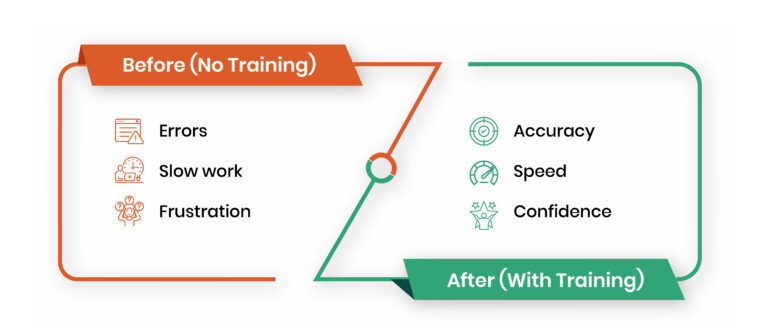
- Employees feel more confident when using SAP systems
Assima Train lets businesses offer modern SAP training solutions that can be used by all employees and still get the same results every time.
Best Practices for Effective SAP Training
There are a number of proven best practices that organizations can use to make SAP training more effective.
Use Role-Based Training
SAP systems are used in different ways by different departments. Finance teams, procurement staff, and HR professionals need training that focuses on the tasks they do every day.
Role-based SAP training makes sure that workers learn the tasks they do most often.
Provide Continuous Learning
Once the system goes live, SAP training shouldn’t stop. You need to keep learning about updates, configuration changes, and new features.
Continuous training programs keep employees confident as systems change.
Measure Training Effectiveness
Companies should keep track of metrics that show if training is working.
Some of these metrics might be:
- How many people use SAP
- How departments use the system
- Less support tickets
Organizations can improve their SAP training plans over time by measuring these results.
Conclusion
Not giving proper SAP training to users can make things very hard for businesses. When employees have to learn complicated systems without structured help, they often make mistakes, work less efficiently, and take a long time to adopt new systems.
Implementing SAP is a big investment, and how well employees use the system is a big part of its success. Companies that put a lot of effort into training their SAP users see better accuracy in their operations, more confidence in their employees, and faster digital transformation.
Assima Train and other similar tools make it easier to provide SAP training that can grow and be interactive. Companies can get their workers ready to use SAP systems well by using both simulation-based learning and real-time help.
Companies that make SAP training a top priority are much more likely to get a lot of people to use it and get the most out of their SAP investments.