

Key Highlights
- Measuring SAP training ROI is essential to justify investment and optimize adoption outcomes.
- Poor user readiness directly increases support costs, errors, and time-to-productivity.
- Simulation-based training significantly reduces training time while improving retention and accuracy.
- Quantifying ROI helps align training initiatives with business performance and executive priorities.
- Tools like Assima’s ROI calculator make it easier to estimate cost savings and efficiency gains upfront.
Introduction
SAP implementations are complex by design. They involve system configuration, integrations, data migration, process redesign, governance alignment, and user readiness. Yet within many SAP project lifecycles, one critical misalignment persists. Testing and training are treated as separate workstreams.
IT teams focus on SAP system testing best practices. Learning and development teams focus on SAP implementation training. Each group works hard, but often in parallel rather than together.
This separation creates friction.
User acceptance testing validates whether the system functions. Training prepares users to operate it. When these streams do not intersect, organizations risk launching technically sound systems that employees are not prepared to use confidently.
SAP testing and training integration strengthens SAP go-live readiness. It ensures that testing scenarios reflect real workflows and that training reflects validated processes.
Assima Train helps organizations remove silos between IT and L&D by combining simulation-based SAP training with reusable test assets. By aligning both functions, enterprises reduce risk and accelerate SAP user adoption before go-live.
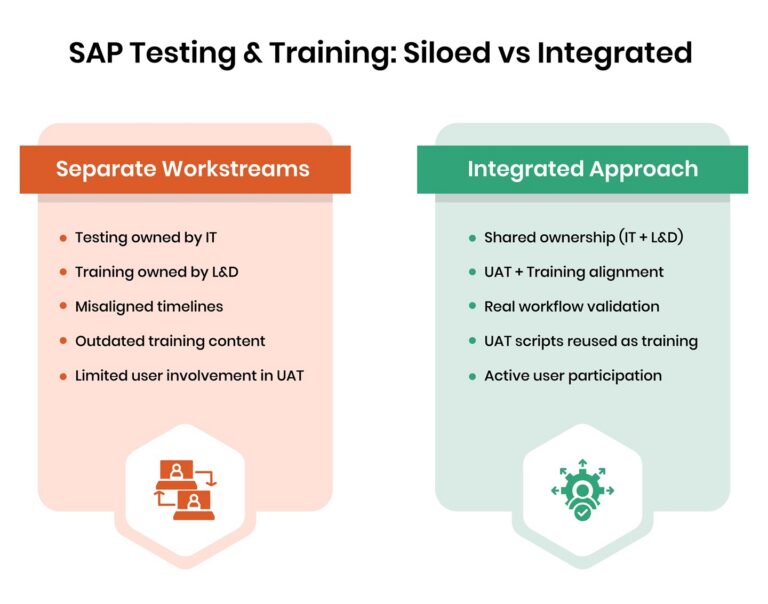
1. The Traditional Approach: Separate Workstreams
In many SAP rollout strategies, testing and training operate independently.
Testing is typically owned by IT or project teams. These teams execute functional testing, integration testing, and SAP user acceptance testing to confirm that the system behaves as configured.
Training is owned by learning and development. L&D designs curriculum, schedules sessions, and prepares materials for SAP pre-go-live training.
While both streams are critical, collaboration between them is often minimal.
Timelines rarely align. Testing may uncover process adjustments late in the cycle, while training materials may already be finalized. UAT scripts may validate system logic but never transition into learning tools.
This fragmented model creates friction:
Training content may reflect outdated configurations.
Business users may encounter workflows during go-live that differ from what they practiced.
L&D teams may lack visibility into testing insights.
Think of it like building a new aircraft. Engineers test components rigorously, while pilots train separately. If their processes never intersect, readiness suffers.
When SAP testing and training remain isolated, organizations miss an opportunity to unify system validation and user enablement.
2. The Hidden Costs of Separation
Separating SAP testing and training produces measurable business impact.
First, user confidence drops during go-live. Employees may complete training sessions, yet feel uncertain when navigating live workflows that evolved after UAT.
Second, training content may be based on incomplete or outdated processes. If system changes occur during final testing cycles, L&D may not incorporate those updates in time.
Third, SAP user acceptance testing often excludes real end-users. Business users may validate scenarios superficially, without gaining meaningful hands-on exposure.
This leads to several outcomes:
- Increased post-launch errors
- Higher support ticket volumes
- Slower time-to-proficiency
- Greater dependency on IT and super users
These issues directly affect SAP digital adoption platform initiatives and enterprise SAP rollout performance.
Consider SAP go-live preparation like rehearsing a stage performance. If actors practice an outdated script, opening night suffers. Even minor inconsistencies create confusion.
The same applies to ERP testing and training alignment. When business users do not practice validated workflows, adoption gaps widen.
SAP testing and training integration reduces these hidden costs by ensuring that validation and enablement occur together.
3. Why Integration Improves SAP Outcomes
When organizations integrate SAP testing and training, outcomes improve significantly.
Testing scenarios begin to mirror real operational workflows. Instead of purely technical validation, UAT becomes a rehearsal environment.
Business users participate actively. They validate processes while simultaneously building familiarity. This strengthens SAP system adoption before go-live.
Integration enables:
- Conversion of SAP UAT scripts into practical learning assets
- Early identification of workflow confusion
- Alignment between configuration updates and training materials
- Stronger SAP go-live readiness
Think of it as combining pilot simulation with aircraft testing. Engineers and pilots collaborate, ensuring the system performs technically and operationally.
Users who practice during UAT develop confidence. They encounter edge cases early. They build muscle memory before launch.
The measurable ROI includes:
- Reduced stabilization periods
- Faster time-to-proficiency
- Lower support ticket volumes
- Higher SAP user adoption rates
SAP testing and training integration transforms go-live from a technical milestone into a business readiness milestone.
Organizations that embed learning into the testing phase move from reactive support to proactive enablement.
Calculate your SAP Training ROI in minutes and see how much time, cost, and effort you can save with simulation-based SAP training.
4. How Assima Train Supports Integrated SAP Testing and Training
Assima Train enables seamless SAP testing and training integration by bridging IT validation and user enablement.
Simulation-Based SAP Learning
Assima Train clones real SAP processes into high-fidelity simulations. These simulations reflect validated workflows and configuration updates, ensuring SAP training during implementation remains aligned with system reality.
Users practice in risk-free environments without impacting production systems.
Reuse UAT Scripts as Training Modules
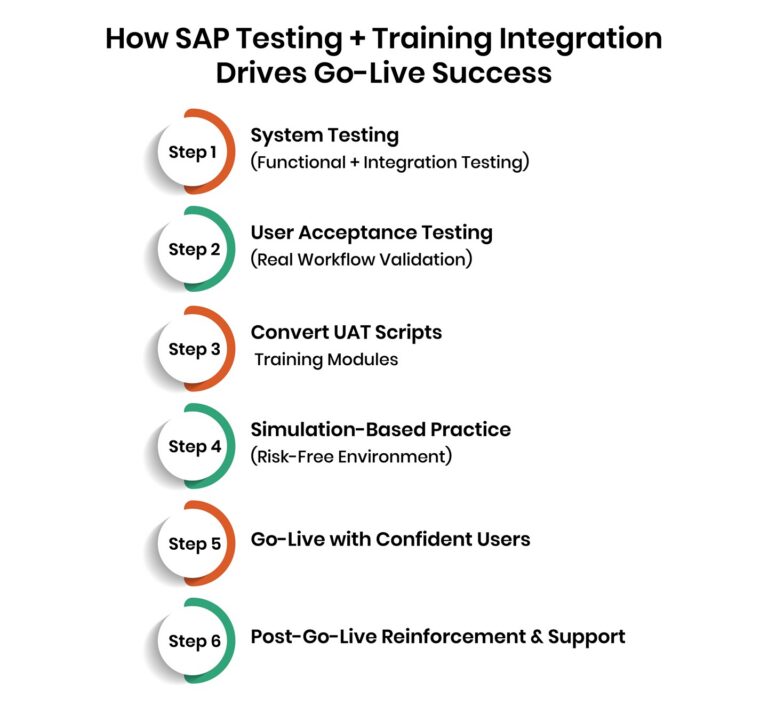
One of the most powerful integration benefits is asset reuse. SAP UAT scripts can be converted directly into interactive training modules.
This eliminates duplication of effort between testing and L&D teams. Instead of recreating workflows, organizations repurpose validated scenarios.
Testing becomes the foundation of SAP implementation training.
Risk-Free Practice
Simulation-based SAP training allows business users to practice repeatedly without affecting live environments. Mistakes become learning opportunities rather than operational disruptions.
This supports SAP pre-go-live training and post-launch reinforcement.
Scalable Enterprise Rollout
Assima Train supports multilingual deployment and global consistency. Organizations can standardize SAP training across regions while maintaining centralized governance.
This reduces training duplication, accelerates enterprise SAP rollout timelines, and strengthens compliance.
By integrating simulation-based learning with system testing assets, Assima Train removes silos between IT and L&D. Testing validates the system. Training validates user readiness. Together, they drive SAP go-live preparation and sustained adoption.
5. Best Practices for SAP Testing and Training Alignment
Organizations seeking effective SAP testing and training integration should adopt structured practices:
- Involve L&D early in the SAP project lifecycle
Ensure learning teams participate in testing discussions and configuration updates.
- Convert UAT scripts into interactive simulations
Repurpose SAP UAT training strategy assets into reusable modules to reduce duplication.
- Use role-based validation during UAT
Allow actual end-users to validate workflows relevant to their responsibilities.
- Align training refresh cycles with system updates
Synchronize configuration changes with learning material revisions.
- Measure readiness metrics before go-live
Track proficiency scores, task accuracy, and scenario completion rates.
This alignment resembles synchronized rowing. When teams move in rhythm, progress accelerates. When efforts remain disconnected, friction increases.
Integrating SAP system testing best practices with training strategy strengthens SAP system adoption and enterprise readiness.
Conclusion
SAP implementations demand more than technical validation. They require operational readiness.
When SAP testing and training operate separately, organizations risk launching systems that function technically but falter operationally. User confidence weakens. Errors increase. Support teams absorb the burden.
SAP testing and training integration eliminates this gap. It ensures that workflows validated in UAT become workflows mastered in training.
Assima Train enables organizations to unify simulation-based SAP training with system testing assets. By converting UAT scripts into interactive modules and providing risk-free practice environments, enterprises accelerate SAP go-live readiness.
Testing confirms that the system works. Training ensures that people can use it.