

Key Highlights
- Integrations make training seamless inside real workflows.
- ERP, CRM, LMS, and analytics integrations are essential for enterprise adoption.
- In-app guidance reduces errors, support tickets, and training time.
- Assima Train enables realistic simulations and scalable enterprise integrations.
- Integrated DAPs improve productivity, adoption, and long-term ROI.
Introduction
Digital transformation is only successful when people use the systems created to support it. Enterprises invest extensively in ERP, CRM, HR, and custom platforms, yet adoption is often slow because people struggle to understand complicated operations. This is where a Digital Adoption Platform (DAP) comes into play. However, not all platforms provide equal value. One of the most crucial aspects of distinguishing effective tools from ineffective ones is digital adoption platform integrations.
Integrations between digital adoption platforms influence how successfully training relates to real systems, workflows, and users. A platform that works in isolation adds friction rather than alleviating it, limiting the impact of software adoption integrations. In contrast, a DAP that is extensively integrated with workplace applications allows for learning while working through in-app guidance integrations.
Modern businesses collaborate across multiple systems, teams, and regions. Training must flow effortlessly between various environments without causing additional work for IT or learners. Assima Train is specifically tailored for large-scale system training and complicated corporate environments, supporting deep enterprise software integration. Its integration-first strategy ensures that training reflects how users actually work, rather than how documentation explains it.
Selecting the appropriate digital adoption platform integrations is not a technical detail. It is a strategic decision with immediate implications for productivity, user confidence, and long-term adoption.
1. Why Integrations Matter in a Digital Adoption Platform
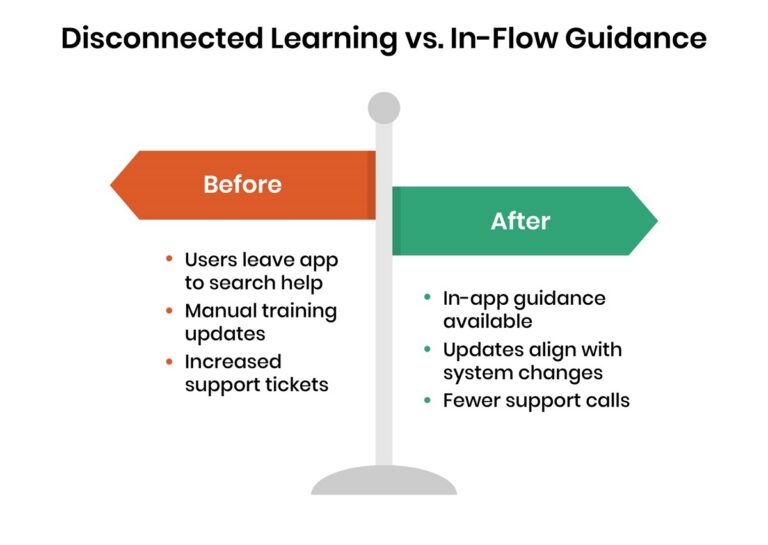
Integrations are the foundation of an effective digital adoption platform. When training operates separately from enterprise systems, users have to pause their work, switch tabs, and search for help. This constant context switching slows learning and increases frustration, reducing the effectiveness of digital adoption tools for enterprises.
Strong digital adoption platform integrations solve this problem by bringing guidance directly into the workflow through system training integration. Users learn while completing tasks instead of stopping to study instructions. This approach shortens time to proficiency and improves accuracy because employees apply knowledge immediately.
Training That Lives Inside the System
When a digital adoption platform connects with ERP, CRM, or custom applications through seamless enterprise software integration, training replicates actual system behavior. Users are shown the identical interfaces, fields, and workflows that they would see in production.
It’s similar to learning to drive in the same vehicle you’d use on the road rather than studying another sort. Familiarity breeds confidence, and confident users commit fewer errors.
Lower IT Effort and Measurable Results
Integrations also lessen the workload for IT workers by simplifying DAP integrations and reducing manual configuration. Training updates remain aligned with system changes without requiring human rework. Integrations are also significant because they connect software adoption integrations with business outcomes.
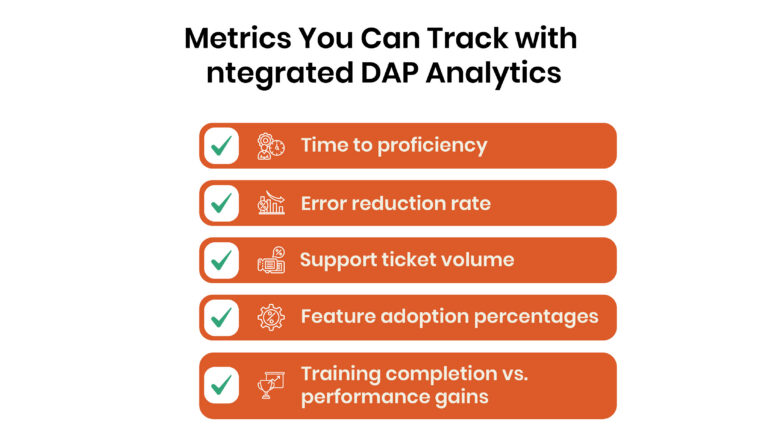
When training solutions link with analytics platforms, organizations obtain insight into where users struggle, which workflows generate friction, and how adoption progresses over time.
With the correct connectors, a digital adoption platform may function as a continuous support layer, driving genuine usage, improved performance, and demonstrable results.
2. Essential Integrations Every Digital Adoption Platform Should Have
An enterprise-ready digital adoption platform must integrate with the platforms that employees use every day through robust digital adoption platform integrations. These integrations ensure that training is relevant, scalable, and effective across enterprise environments.
ERP integrations
ERP systems, such as SAP and Oracle, help manage fundamental business activities. ERP integration for training enables users to simulate workflows, understand dependencies, and execute jobs correctly. Without ERP connectivity, training becomes theoretical and disconnected from real operations.
CRM integrations
CRM integration with a digital adoption platform benefits sales, support, and customer success teams. Users learn how to update records, manage pipelines, and handle cases directly within the CRM, improving accuracy and customer outcomes.
LMS integrations
LMS integration with a DAP connects structured learning with real-time, in-app guidance. Organizations can assign courses, track completion, and reinforce learning through contextual prompts, combining formal learning with in-app guidance integrations.
Collaboration tool integrations
Modern digital adoption tools for enterprises should integrate with collaboration platforms like Microsoft Teams or Slack. These integrations support shared learning, notifications, and peer assistance, especially in distributed environments.
Web applications and custom systems
Many enterprises rely on homegrown or industry-specific platforms. A strong DAP must support web applications and proprietary systems through flexible system training integration, without requiring redevelopment.
Analytics platform integrations
Analytics integrations connect training activity to business performance. By integrating with analytics platforms, organizations gain visibility into adoption trends, task completion, and error patterns, key insights for optimizing software adoption integrations.
Together, these digital adoption platform integrations ensure training supports onboarding, daily productivity, and long-term system adoption.
Get the guide top enterprises use to evaluate digital adoption platforms.
3. How Assima Train Supports Enterprise System Integrations
Assima Train is built to operate across complex enterprise environments and supports deep digital adoption platform integrations with SAP, Oracle, CRM platforms, and custom applications.
Instead of relying on overlays or superficial guidance, Assima Train uses real-world simulations that mirror actual system behavior. Users practice workflows exactly as they will perform them in production, supporting accurate system training integration without risking live data.
Assima Train delivers in-app training integrations that align directly with enterprise applications. Users receive step-by-step guidance while completing tasks, reducing reliance on manuals and support desks.
Multilingual support ensures training scales globally. Organizations create content once and deploy it across regions, supporting consistent adoption across diverse teams.
By combining deep system compatibility, realistic simulations, and scalable deployment, Assima Train integrations support enterprise software adoption at scale.
4. Factors to Consider When Choosing a DAP with Strong Integrations
When analyzing digital adoption platform integrations, businesses should look beyond surface compatibility and consider long-term usability and scale.
- System coverage
The platform should smoothly support ERP, CRM, LMS, and custom applications through comprehensive enterprise software integration.
- Security and compliance
Integrations must meet enterprise security standards and protect sensitive data.
- Scalability
A strong DAP should support thousands of users across regions without performance issues.
- Reduced IT workload
Integration capabilities should simplify updates and reduce dependency on technical teams.
- Flexibility for future changes
Integration requirements evolve as systems change. The platform should adapt without forcing training redesigns.
5. Benefits of a Fully Integrated Digital Adoption Platform
Organizations that invest in a strong digital adoption platform with robust integrations see clear improvements in how people use systems day to day. Adoption improves, productivity increases, and users feel more confident working in complex enterprise applications.
What this looks like in practice:
Faster time to proficiency
Employees learn while working in real workflows through in-app guidance integrations, which helps them apply what they learn immediately and ramp up faster.
Lower IT support load
Contextual guidance inside enterprise systems reduces common mistakes, so IT teams spend less time answering the same questions again and again, one of the key advantages of effective digital adoption platform integrations.
Consistent training at scale
Teams across roles, systems, and regions receive the same quality of training through standardized system training integration, even as enterprise platforms continue to change.
Better user experience
Instead of feeling overwhelmed by manuals, videos, or scattered resources, employees feel supported at the moment they need help using digital adoption tools for enterprises.
Smarter training decisions
Analytics integrations show where users struggle and where adoption slows down, helping organizations optimize software adoption integrations and improve outcomes over time.
Overall, an integrated digital adoption platform helps organizations move from reactive training to continuous, practical support.
Conclusion
Digital adoption depends on more than content alone. It depends on how well training connects to the systems employees use every day through robust digital adoption platform integrations. When learning is embedded into real workflows, users gain confidence faster and make fewer mistakes.
For organizations operating complex ERP, CRM, and custom applications, Assima Train delivers deep system training integration, realistic simulations, multilingual support, and scalable deployment. This approach ensures training stays aligned with evolving systems without increasing IT effort.
With the right software adoption integrations in place, enterprises reduce friction, accelerate user adoption, and maximize the long-term value of their technology investments, turning digital transformation into real, measurable progress.